 SELECTED FOR DEPARTMENT OF WAR SUSTAINMENT MODERNIZATION PROGRAM

CASE STUDY 07 · Robotics · Prototype to Production
How a Robotics Startup Found Up to 20% Part-Cost Savings
Cost engineering before design freeze · November 13, 2026
01 / THE OUTCOME
Make cost-saving opportunities visible while the design can still change, not after supplier quotes and purchase orders lock it in.
Estimated bracket-group cost reduction at the customer’s planned production volume
Projected recurring cost reduction for the standardized sheet-metal part family
Opportunities identified before drawings were finalized
The challenge
A fast-growing robotics startup needed a structured cost-engineering review without pulling its small team away from getting a working prototype into production. Larger manufacturers routinely bring design and mechanical engineers together to review a bill of materials (BOM). Early-stage companies often lack that bandwidth and multi-cycle manufacturing experience. Costly part choices can go unnoticed until drawings are released, suppliers are quoting, and orders are already in motion.
The solution
The customer uploaded CAD files, drawings, and part data for a few hundred parts across several sub-assemblies. Arcessio automatically parsed geometry, materials, and source files, then surfaced opportunities for part consolidation and material and design commonality. For each opportunity, the platform estimated cost before and after the change. The customer could adjust current price, one-time engineering cost, and expected production volume to evaluate the breakeven point.
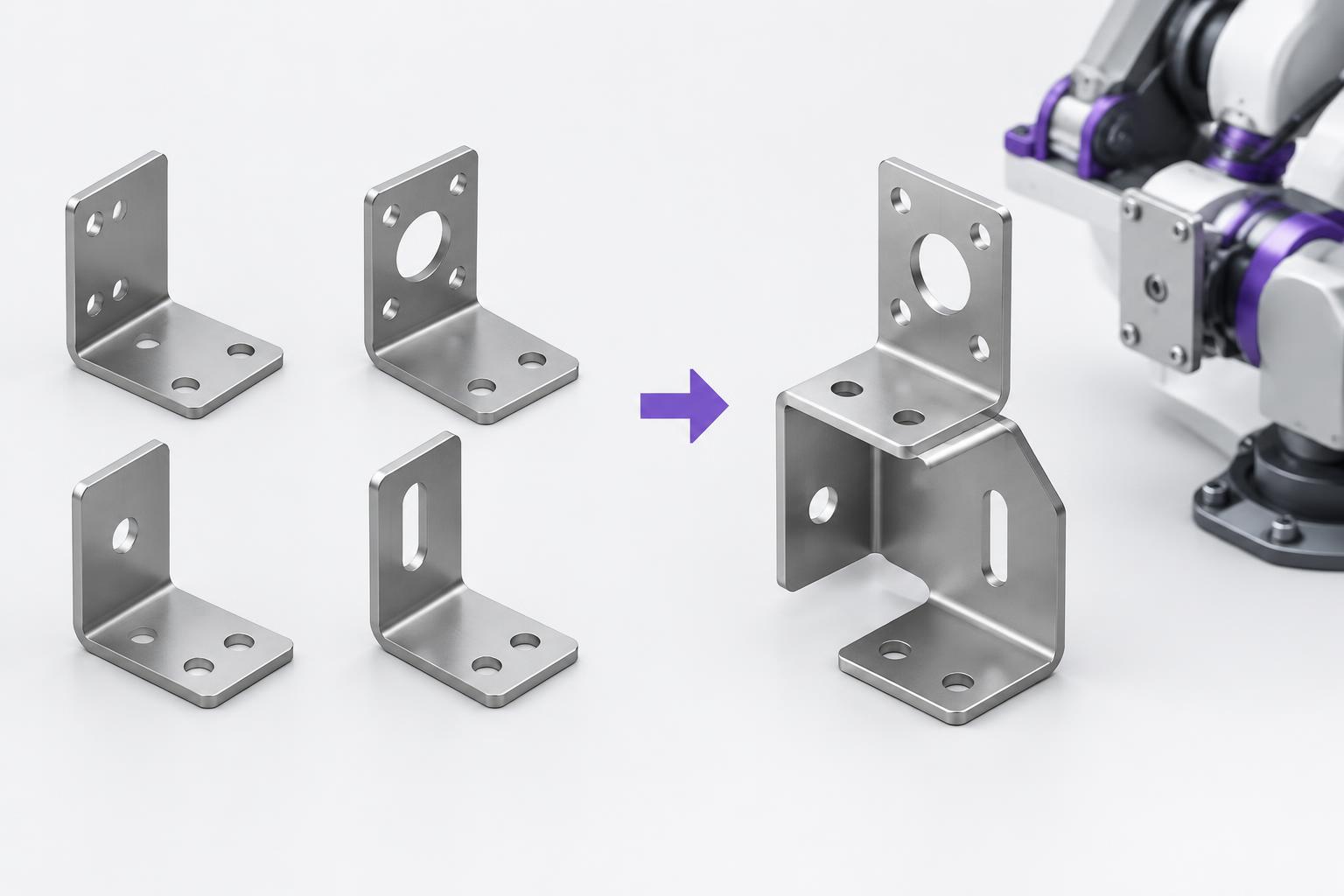
Four brackets. A simpler assembly.
Four separate sheet-metal brackets in one corner assembly could be consolidated into a single formed part, or reduced to three parts. The consolidation opportunity cut the estimated cost of that group by roughly 20% at the customer’s planned production volume, while leaving material and tolerances unchanged.
One shared design instead of several variants
Across the broader BOM, several two-millimeter sheet-metal parts used slightly different versions of the same basic design. Standardizing them into one variant, with a shared hole and thread pattern across use cases, was projected to reduce recurring cost for that part family by roughly 19%.
Why timing changes the economics
Cost optimization is often downstream: teams get quotes, start building, and only then roll up assembly costs. By that point, high-cost parts may be locked in and excess stock may have been ordered to reach a volume break. Even a cheaper redesign cannot be used until existing inventory is consumed.
Analyzing parts before drawings are released avoids that trap. There may be no before-and-after supplier invoice yet, so Arcessio generates should-cost estimates for the original and optimized designs. This makes avoided cost visible before either version has been quoted.
The takeaway for hardware startups
Early-stage manufacturing and supply-chain teams are often just three to five people, focused on ordering parts and keeping production moving. Arcessio brings a cross-functional, cost-aware engineering review into that workflow without requiring a startup to hire a dedicated cost-engineering team.
Review the BOM before the next design freeze. Consolidation, material standardization, and sourcing opportunities are easier to act on while the team still has design flexibility.
Manufacturing intelligence used
- BOM Analysis
- Part Consolidation
- Material & Design Commonality
- Should Cost
- Breakeven Analysis
Ready to explore your parts?
Discover manufacturing opportunities in your drawings, CAD, and specifications.
Start using Arcessio